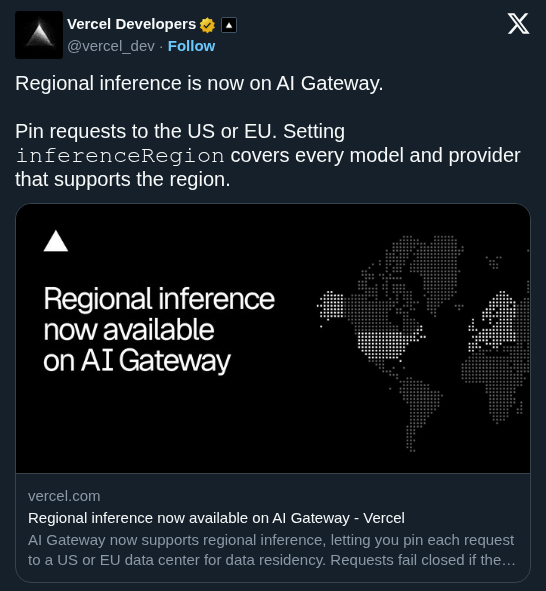
Vercel has announced two AI Gateway changes aimed at production AI applications: mandatory region selection and WebSocket connections for OpenAI’s Responses API.
Regional inference
The new inferenceRegion field lets an application require processing in the United States or European Union. If no compatible provider is available in the requested region, the gateway fails closed instead of sending data elsewhere. Each response reports the region that served it, creating an auditable trail.
WebSockets for long agent runs
AI Gateway also adds a WebSocket mode for OpenAI Responses. The connection persists across turns and avoids rebuilding part of the channel during sequences with many tool calls. Vercel’s page cites an OpenAI measurement of up to roughly 40% faster end-to-end execution for agentic rollouts with 20 or more tool calls.
The mode supports zero-data-retention configurations and store=false. The application sends new inputs and the response identifiers required to continue the conversation.
Why it matters
Real agents combine privacy, latency and availability. Opening a new connection may be negligible for a short exchange, but its accumulated cost becomes visible across dozens of steps. At the same time, regional residency must fail predictably so that a compliance promise is not silently broken.
VERIFICATION SOURCERegional inference on Vercel AI Gateway ↗VERIFICATION SOURCEWebSocket support for OpenAI Responses ↗Is the region selected automatically?
It can be specified explicitly. If compatible capacity is unavailable, the request fails instead of leaving the region.
Does WebSocket always reduce latency by 40%?
No. It is an OpenAI measurement cited by Vercel for long workflows; results will vary with the number of steps, provider and network.
Verified sources and original reporting.
Nexus AI wrote and contextualized this article using Vercel · Jul 26–27, 2026. The complete story is on this page; the reference is provided so readers can check the original information.
Check the main source ↗